Good evening, church. My name is Bradley. I'm one of the pastors here on staff alongside Jonathan, and I usually do the music, but we have a wonderful team here tonight that has led us through worship so that I could spend tonight bringing God's word to God's people. And I'm thankful for this opportunity and thankful for all of you who are gathered here tonight.
Now, earlier, I want to draw attention to the fact that we sang one of, in my opinion, one of the greatest hymns of all time. And within it, we said these words together. Riches I heed not, nor man's empty praise. And we're saying it beautifully, but tonight's text is going to reveal what it looks like when we mean it. Because tonight's text is nothing but lighthearted and gentle. I'm just kidding. It's about politics and taxes two weeks before the midterm, nonetheless.
Now listen, I did not pick the text. The lectionary did. So if you have any complaints, please just take it up with the lectionary. And to be completely transparent, Jonathan asked if I wanted to change the text for this week, because it's been about a year and a half-ish since I've given my last sermon. And obviously, this is my first one with you all. And for it to be about politics and taxes, well, that's kind of a hard pill to swallow. But I believe that the path laid out by the lectionary, it does something honest. It prevents us from just cherry-picking the text and scripture that we want, that we choose, that makes us feel warm and fuzzy. It forces us to face some of the uncertainty and discomfort that's inevitable when we follow Jesus.
So that being said, I'm also aware that I'm a millennial about to preach on money to a room full of people who have actually balanced a checkbook in their lives. Listen, that's a bit like taking cooking lessons from a guy who my signature dish is McDonald's, right? But stay with me. Trust the process. And I promise most of us will make it through the other side alive.
So a couple of ground rules before we even get started. Remember that Jesus loves everyone, Republicans, Democrats, and even especially the ones who want to see the yard signs just go away. So that being said, let's draw attention to the text. Beneath the argument about taxes, Jesus is asking a much bigger question here. He says, whose image do you bear? And if that image tells us to whom we belong, then another question naturally follows. How far are we willing to follow the one to whom we belong?
So I believe that those questions lead us to, of all places, to a farm in Georgia in 1940. Now, this guy up on the screen, this Clarence Jordan, this man in 1942, he was a Baptist preacher who helped start a farm on the tired red clay of Americus, Georgia. See, Clarence, he held a PhD in Greek New Testament. And somewhere in all of that study, he became convinced of something equal parts disruptive and dangerous, that maybe, just maybe, Jesus actually meant what he said. To Clarence, the Sermon on the Mount was more than just poetry to be admired. It was a life to be lived, a template to apprentice under.
So Clarence and his friends gathered everything, came together, and they named the farm Koinonia, which is the Greek word used for fellowship. It's the word that Luke uses in Acts to describe the life of the first church. Now, does that sound familiar? Yeah. If you spend any longer than two weeks here, then you might recognize this phrasing. And if not, perfectly fine. Just hold tight. I promise we're going to circle back to it at the end. No one will be left behind.
So back to Koinonia. Listen, they shared the same fields. They did the same work. They shared what they earned. They ate at the same table. And in the Jim Crow South, that table was the scandal. See, black and white families, they sat together and called each other brother and sister. Now, at first, their neighbors thought they were a little strange, but eventually, they decided that these people were dangerous. Stores refused to sell them supplies. Banks closed their accounts altogether. The roadside market where they sold the produce, well, it was dynamited, something that we don't even hear of anymore. Now, shots were fired into the houses while children slept inside. And one of the most painful parts of this story is that some of the opposition came from church people. The people who enforced the boycott during the week, they could be found in the pews on Sunday morning.
So in the middle of all of this, Clarence went to go seek wise counsel, as we're told to do in scripture. So he went to go see his brother, Robert. Now, this on the screen, this is Robert. Robert was a lawyer with a very promising career. He would later serve as a state senator and even a justice on the Georgia Supreme Court. Clarence asked his brother, Robert, can you represent Koinonia, to which Robert, his brother, both in blood and in Christ, said emphatically, no way, I cannot, no, I'm not touching this. It could cost him his job, his home, his political future. Clarence reminded him in that moment that they had joined the same church, right? The same church as boys. They were both baptized at the same time. They even answered the same exact questions about accepting Jesus before being baptized together. And now Robert finally said this, honestly, I follow Jesus, Clarence, up to a point. Robert would go on to state that I follow him to the cross, but not on the cross. I'm not getting myself crucified.
And Clarence responded that Robert might be an admirer of Jesus, but you're no apprentice. Because we can all agree, right, that there's a wide gap between being an admirer and an apprentice. An admirer, well, we can appreciate what's happening around us, but an apprentice dedicates their life to following and learning. Only one of these two things comes with a cost.
So I want to be careful here, because to be honest, I'm not sure I would have answered any better than Robert. Most of us wouldn't, if we're honest with ourselves, because he was afraid, we're afraid of losing real things. His work, his home, his security, these were not small fears. These are real things. So we love Jesus. We admire Jesus. We want to follow Jesus up to a point. And sometimes that point is our reputation. Sometimes it's our mortgage. It can be our comfort, our tribe, our money, our sense of security. But we find out what that point is when we follow Jesus. And when following Jesus leads us to the place of letting go of something that we so desperately want to keep, something that we feel like we cannot live without.
See, 2,000 years ago in the temple courts of Jerusalem, these religious and political leaders came looking for a point at which Jesus' allegiance would break. So let's look at the text. Matthew says that the Pharisees plotted how to entangle him in his words. This is the language of a snare. They're not looking for the truth. They're looking for a soundbite. And notice that the strange coalition that's happening. The Pharisees sent their disciples along with the Herodians. The Pharisees, they resented Rome's occupation, right? But the Herodians were associated with a political order that supported Rome. These two people, they disagreed about plenty, but they found common ground in this common threat, our Jesus, our Christ. Nothing unites rivals like a shared enemy. It's the same reason why two siblings who have fought all day long instantly team up against bedtime or bath time, right? They begin with flattery in this instance. They say, teacher, they try to butter him up. We know that you are true. You teach the way of God. You do not care about anyone's opinion for you are not swayed by appearances. In other words, he shows no partiality.
So then comes the question, the gotcha. Is it lawful to pay taxes to Caesar or not? Now, to fully understand this trap, remember where we are. Remember the backdrop. Remember the setting. This is Holy Week. Jesus had just entered Jerusalem with the cries of Hosanna. The city is wondering whether this, this man, this one will be the one to throw off Rome.
And this tax was just not any tax. Now, quick history lesson. Does anyone like history? I didn't think so. Let's go for it. When Rome took direct control of Judea in AD 6, the Roman taxation provoked a revolt associated with this man, Judas the Galilean, whose cry reverberated throughout the empire. No king but God. No king but God. This cry was silenced quickly when this Judas was killed by Rome for treason. But it still reverberated in the hearts of the people filling the streets, crying Hosanna. The people, the same people, that filled the temple and watched while this question was being asked. See, this tax was a reminder of who held the power. Say yes, and Jesus risks alienating those who have longed for liberation. And say no, and his opponents can accuse him of rebellion against Rome, ending his ministry quickly.
So Jesus, being who he is, he's right through it and into the hearts of the accusers. He asks, why put me to the test, you hypocrites? Show me the coin for the tax. Now notice this. Jesus asked them to bring the coin. This meant that these men who have come to question his loyalty, they're the ones who can produce the symbol of Caesar's authority. And do you see this?
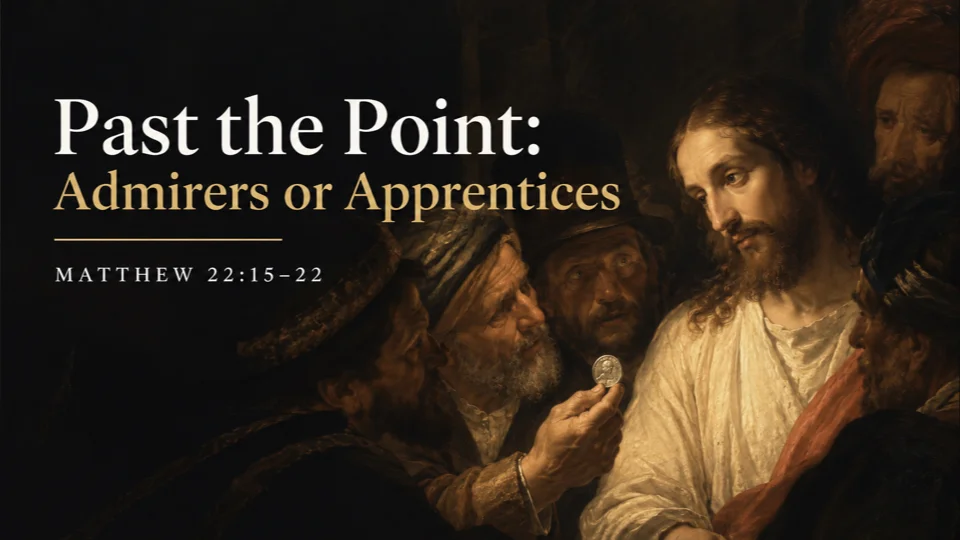
Now, I'm more of a visual learner, so I want to show you this painting. This is Rembrandt, the tribute money painted in 1629. Now, I love the way that Rembrandt painted this moment, when he was just 23 years old, by the way. This painting is not much bigger than a cafeteria tray, but look how much of the story he's able to put into it. Let's get a closer look. Let's start with the men here. They press in around Jesus, leaning toward him as if they have him cornered. Rembrandt even makes it a point to make the men in the foreground smaller so that Jesus seems to dominate the scene. See, they came to make him feel small, but the painter made them feel small instead.
And this is a key point. Look at the light. Rembrandt is known for his unique style of using light and darkness, in which he uses the light often to depict where the holy is present, or where God is entering into the darkness and dispelling it. Notice where it's gathering. We see, of course, it's the light is emanating from the head of Christ, but also notice the light is coming in from behind the accusers, while their faces are shrouded in shadows, as if they had turned their backs onto what is true and holy.
And before I get any further, look at the coin, the denarius. Now, a denarius at this moment isn't much larger than a dime, but look, it's oversized here, almost comically so. In a scene full of religious leaders, look at the men's focus. Look at their focus. It appears to be on what? Not Christ, not God in their midst, not the lightness at their backs. They're focused downward on the coin. And there's another detail that we don't see here, and it's the fact that Rembrandt signed this painting with his monogram RHL. And centuries later, experts have studied that signature with x-rays and infrared scans to establish whose work is this. And it seems fitting that even the painting raises a question about a name. Whose name is written here? You see?
So now, hear the question that Jesus asks as he holds up the coin. Whose likeness and inscription is this? To which they answer, Caesar. And then the phrase that we're all familiar with, right? Therefore, render to Caesar the thing that are Caesar's, and to God the things that are God's.
To render, to give back. Listen, Jesus is not dismissing all earthly responsibilities or civic responsibilities. Now, taxes and civic obligations are real, but he puts those responsibilities in their proper place. Because Caesar's claim is not unlimited. Jesus doesn't say here that money is evil. He just makes it small. Small enough to hand back or to give back. Like, as if Caesar can have his coins, but he does not get to have you. And suddenly, the question hanging over the courtyard isn't, should we pay the tax? It's this. If this which bears Caesar's name and image belongs to Caesar, then what belongs to God? What belongs to God?
See, Jesus asks about two things, the image and the inscription. And as you see it, Denarii from this period bore the image of Emperor Tiberius, right? Denarii from this period showed the inscription which proclaimed imperial authority, even associating the emperor with divine status, saying that he's the high priest or the son of the divine Augustus. Roman coins were not just a currency. They carried Rome's claim into every market and pocket, reminding everyone, this is who rules. This is who you owe. And the word Matthew uses for this is icon or likeness, a word that harkens back to the Old Testament in Genesis 1:27, when it said that God created man in his own icon, in his own image. Do you hear what Jesus has done? The coin bears the image of Caesar, but you and I and we, we bear the image of God. Caesar put his face on little pieces of silver, but God has given his image to us. So give Caesar what bears Caesar's image, but give God what bears God's. Not just your Saturday nights or your Sunday mornings, not just part of the income that you can comfortably spare, not just the opinions in which you're comfortable sharing or I'm comfortable sharing, your life.
And here's where the two questions become one. If God's image tells us whose I am, then following Jesus is learning to live like I actually belong to him. It's one thing to say I belong to Christ, but it's another to let Christ have the final word over my money, my reputation, my relationship, my politics, and my future. Think back to Robert Jordan. He confessed Christ. He loved the church. He was not saying that Jesus was wrong. He was just being honest when saying that there were just something that he was not willing to lose. But that point in which he stopped following Jesus revealed where another claim had become stronger than his obedience to Christ. And that's the uncomfortable question for us tonight. When loving a neighbor will cost me my comfort, when forgiving someone will cost me my pride, when telling the truth costs me my standing and reputation, when following Jesus costs me the approval of my community, whose claim will govern my life.
So before we take another step, hear this clearly. We do not belong to God because we follow Jesus far enough. We follow Jesus because we already belong to God. We do not earn his love by crossing yet another more difficult line. See, grace came first, and our discipleship, our apprenticeship is our response to that grace. The question is, is whether we're we will allow the one to whom we belong to let him lead us past the places where we used to stop.
Now, do you guys know this? The coins, why coins have ridges around them? See, when coins were made of silver and gold and precious metals, people, us, we would often shave off a little metal from the rim and spin the coin as if it were a real coin. And that's what we're doing. We're shaving off a little metal from the rim and spin the coin as if it were whole, as if it retained all of its value while also holding something back. Okay, some of you are already getting ahead of me. Let's slow down. See, the ruler's image remained, but a little bit of the coin was held back. You see what's happening? That's something that we all try to do. We don't refuse God out, right? We offer ourselves mostly. We just keep a little off the edges, a little resentment, a little control, a little corner of our lives where we say, Jesus, you can go this far, but no further.
But the zealots wanted Jesus to oppose Caesar completely. The Herodians on the other side wanted him to accept the imperial arrangement, but Jesus refuses to make Caesar either his enemy or his Lord. In this instance, Caesar became small, a ruler who just seems to collect coins, right? And God's claim becomes in this moment wonderfully yet uncomfortably large that each and every person, you, I, we, who bear his image and belong to him, even the people trying to trap Jesus, we belong to him. And that coin has never really gone out of circulation. Caesar's face has changed, but the temptation to give something else our ultimate allegiance, it hasn't.
So let's hold this question in two places in our lives tonight, our nation and our community. Now to a nation in election season, a little over two weeks, our nation will go to the polls yet again. And I'm not going to ask you or, well, I'm not going to tell you how to vote, but I will ask what Jesus' question requires us to ask, whose name is shaping the way that you vote, shaping the way that you live? Because the danger is not that we as Christians care about politics. We absolutely should. Loving our neighbor means caring about the laws and leaders and decisions that will affect their lives. The danger comes when politics stop being a responsibility and it becomes our identity, our belonging, and our sense of ultimate hope. A party can ask for your vote, but it should not and cannot have your soul.
And in my writing and research about the lines that we draw between one another, I return often to this theory called the social identity theory. Now it's that psychologists have found that people can divide themselves into groups by something absolutely meaningless, trivial, and very quickly begin favoring their own group over another because we don't only hold opinions, we belong to them. And then once we belong to them, we start defending our side as if we're defending ourselves. Have you ever seen this happen? Yeah. That defense becomes fear. Fear becomes suspicion. Suspicion then becomes contempt. And contempt becomes the permission that we give ourselves to stop loving another person, to stop loving across party lines.
Now, before I came here and before I was at the Church of the Cross, I worked also as a chaplain and saw how those divisions can become, well, how small those divisions can grow. When I sat with people in the hardest hours of their lives, and oftentimes in the last hours of their lives, and I've held hundreds of hands, listened to hundreds of confessions, and sometimes sat with people who had no one else nearby, and not once did anyone at the edge of eternity ask me how I voted. Because at those bedsides, people want to know whether they're loved, whether they're forgiven, whether someone would stay. And so at this point, at the edge of eternity, Caesar grows very small, very quickly.
So how do we learn to see that clearly now before we're facing our last moment? Maybe the warning signs are closer than we think. When I'm more anxious about the results of an election, then I am confident in the resurrection. When my bank account has more conviction than my Lord does. When a Christian who votes differently feels further away from me than someone who shares my politics, but not my faith. When following Jesus requires me to love someone that I want to despise, yet I still refuse to seek peace. See, that takes us straight back to the very thing that we've wrestled with, the very thing that keeps us from seeing and experiencing the kingdom of God here and now, the very thing that Robert Jordan so honestly took all of our anxieties and all of our fears and all of our shame, and he put it into words, I follow Jesus up to a point. And we all know that feeling too well, that Caesar doesn't only campaign, he goes to church. Remember, Robert Jordan was not a pagan, he was a church member. And the deepest wound in the Koinonia story was that Christians can confess the same Lord and then refuse to sit at the same table.
Now, our circumstances in Bluffton are very different, thank God. The most hostile thing around here is probably the roundabout at New Riverside. Oh, wow, I didn't expect that to get kicked like that. Yeah, I guess you all feel the same way. But there are quieter ways to let another allegiance stop us or shape us.
See, our town, it's growing fast. I don't know if you know this, churches can begin to compete. We start to ask, who's growing, who's shrinking, who gets the credit, who has the better programs? We can speak of that church with the slightest of eye rolls, and you know the one you're picturing right now, so am I. But that, that's Caesar's economy. Territory, market share, brand loyalty, listen, the kingdom of God does not run on that economy. The name written over our church is not ours, it's his. And it's the same name confessed by Baptists, by Methodists, Catholics, Presbyterians, Lutherans, Anglicans, a church meeting in a school in the large congregation down the hallway, I mean, down the highway, we're not rivals, people, we're not competitors in the work of Christ. We are members of one family, serving one community in one town, and we know something about this firsthand, right? Every Saturday evening, we worship here as guests in the home of Lord of Life. Another congregation has made room for us at their table. And our mission has been and will always be to plant a reproducing church in Bluffton and beyond. But you can only do that if you're willing to give people away. You have to care more about the kingdom growing than about your own name on a sign, which we don't even have, by the way. So when another church in Bluffton flourishes, can we be the first to celebrate? When their staff or their pastors, or they grow weary, can we be the first ones to call and offer help? When a family finds a faithful church somewhere else, can we just rejoice? Because the question is not what church gets the credit, the question is whether we are willing to follow Jesus past the point where our desire for recognition tells us that we need to stop.
So how do we learn to live into whose we are? How do we transform from an admirer to an apprentice? Well, I want to tell you a story. In 1973, psychologists, researchers at Princeton, they asked seminary students to go to another building to give a short talk, a short sermon, and some were even assigned to lead the church. And they gave the sermon, the parable of the Good Samaritan. And along the way, they passed a man who appeared to be in need of help. The students, who thought they were late, were much less likely to stop, even when they were on their way to speak about the parable of the Good Samaritan. See the Do you want to take a guess on what percentage? What percentage decided to stop? Half? Okay, a quarter? No, one in 10 seminarians in a hurry stopped to help, on their way to preach on the Good Samaritan. These people, these future religious leaders, I'm going to argue tooth and nail that these weren't bad people. They were just busy. Something else had a claim on their time, something that they were caught up in this crazy little thing called life. But think about it, just think about it. We can know the parable by heart and still walk past the person in the ditch.
And remember that, take a look at this. This is another painting or etching by Rembrandt. He didn't choose to etch the dramatic rescue on the road. No, he painted the arrival at the end. At the end, the wounded man being lifted down from the horse of the Samaritan, arranging the pay for the care of a stranger. Not the moment that looks heroic from a distance, the inconvenient one that cost him time and money. Think of the two paintings next to each other. In the first one, Jesus is holding up a coin and asking whose image is on this. And in this one, a man uses what he has to care for someone who bears God's image, bears that image. The first painting asks us to whom we belong to. And this one shows what it looks like to actually follow Jesus when that belonging costs us something. Because admiration lives in what we approve of, but apprenticeship takes shape in what we practice. Dallas Willard reminds us that grace is not opposed to effort, it's opposed to earning, that we cannot earn the image of God that we already bear it. We cannot make Christ love us by becoming better disciples. He has already loved us first, but by grace, we can continue, we can practice living as people who actually belong to him.
Think about this. Caitlin and I, we write Liam's name on everything, nearly everything he owns, right? We write it on his cup, his jacket, his backpack, his toys, it's everything. Not because writing his name on those things make those things his. They already belong to him, right? We write it on his cup, his jacket, his backpack, we write it because things wander. They get picked up by other hands, and the name helps them find their way back home. Our hearts wander too. Other voices get a hold of our attention. Fear and outrage, they become habits, but I believe prayer and generosity and love can become habits as well. Because the psychologist Emmy says that neurons that fire together wire together, but to translate, what we practice repeatedly shapes what we reach for instinctively. What we practice repeatedly shapes what we reach for instinctively.
So here are four practices for the next month, not to earn God's love. These are ways to let that truth of his love reach further into our lives. First, in the morning, give yourself back first, before you reach for your phone or your newspaper, for those who still read the newspaper, bless you, open your hands and pray. Before anything, say, Lord, I belong to you. Write your name on me today. And before any other voice gets a vote, let his be the first.
And two, says fast from the feed. What does that mean? Okay, every sermon I've ever given, I try to say in some or no amount of words, lay off Facebook. But in this instance, set aside one day each week, where you don't look at the political news or social media. And if that's too hard, give those voices just a limit, an hour or two a day where you're saying not between the hours of four and five. Notice what happens when you're not checking, notice what happens when you're not checking. Sometimes that little itch reveals just how much power we have given something that was supposed to be so small. All right, and three, pray for the people that you would otherwise resent. Choose one leader or that you or one person that sees the world differently than you do, pray for them by name, for their health, for their family, for their flourishing, not merely that they would change their mind. This is what love looks like, that the image and description that they bear must be more important than the labels that we put on them. And it's hard to keep treating someone as if they're the enemy, if we keep bringing that person to the father first.
And lastly, you notice these things are getting more difficult. Lastly, number four is to cross the line over a meal. I've always been told as much as I can imagine, we have all been told, don't talk about religion and politics at the table, right? But before the election, I'm inviting you to do just that. Invite someone to dinner who sees the world differently. And don't debate, ask good questions. Listen more than you speak and most importantly, serve good dessert. Because it's very hard to stay angry at someone when you're eating good banana pudding.
And notice what all of these have in common. Each one asks us to follow Jesus just a little further into a part of the life that we might otherwise keep for ourselves, the little part that we shave off and hold from God.
Our church's verse, one of them has always been and will always be Acts 2:46. And day by day, attending the temple together and breaking bread in their homes, they receive their food with glad and generous hearts. And a few verses earlier, Luke uses that word, same word, koinonia, to describe the life that the believer shared in the first church. It's the same one that Clarence Jordan chose for their farm in Georgia. But notice the rhythm in Acts, worshiping together and breaking bread in their homes. That's the rhythm that we're trying to learn here within our church. We gather on Saturday evenings around the Lord's table. But during the week, we gather around the kitchen table across Bluffton through Table 246. This ministry to meet in houses, share a meal together and share life together. We open our doors, we open scripture and we open our hearts to one another. Because Caesar is training to sort people into sides, but Christ trains us to make room for all at the table. And no one's going to check whether you've completed your homework or not. Listen, I'm not your third grade teacher, but God makes room for your freedom and so do we. Nothing here is obligation. It's all invitation. And out of all these invitations, most likely none of them will make huge headlines. But that's the way of Jesus, right? The way of Jesus is through small, repeated acts of surrender until one day you notice that the point where you used to stop following Him, that's just moved a little bit further. Until by grace, the point where we once stopped is in the rear view.
So in closing, I want to say that I just want to return back to Clarence Jordan one last time for a few seconds and say that Koinonia survived, but barely. Because when the boycotts closed the markets, Clarence and the community came up with a new opportunity. They sold pecans or pecans. I say pecans, okay, because pecans is something completely different. But yeah, so he sold pecans all around the country with a slogan that only he can get away with. He said, help us ship the nuts out of Georgia. And it became popular. Orders came from around the country and eventually the hostility eased. And from the life of that community, from Koinonia, came the work that helped inspire Habitat for Humanity and its commitment to decent housing alongside families who desperately need it. See, that's what can happen or can grow when people refuse to let the world's boundaries become the boundaries of our obedience. And I pray that we can push past what is comfortable in order to grow into what is necessary. So let's pray.